
The other day I was browsing YouTube and stumbled across an old Michael Jordan interview that captured something I’ve been thinking a lot about lately. In part of the piece, MJ was discussing the public perception that his stint as a Major League Baseball player was a failure. Here’s what he had to say:
All people think about is that ‘he batted .202 and he struck out a certain number of times’... well okay, yes, but the effort was there and the learning curve, and the passion was there, that this transcended not just to me, but to other people who are afraid to do things because they are worried about the perception that may come from other places.
Michael Jordan
The part I’d like to zoom in on is his mention of the learning curve — which is what I’ve been riding for more than a year and a half en route to Spanish language mastery and in upskilling for my next career as a software engineer.
To essentially be learning two languages at the same time hasn’t been easy. Every day I’ve had to shift mental gears — from learning the rhythm, structure, and sounds of Spanish to the logic, syntax, and flow of Java.
It’s like I’ve been riding two learning curves at once. So I’d like to share some of the wisdom I’ve picked up about achievement and mastery along the way.
What Is the Learning Curve?
Simply put, the learning curve is the idea of a person gaining skill, knowledge, or efficiency in a given area over time and with practice.
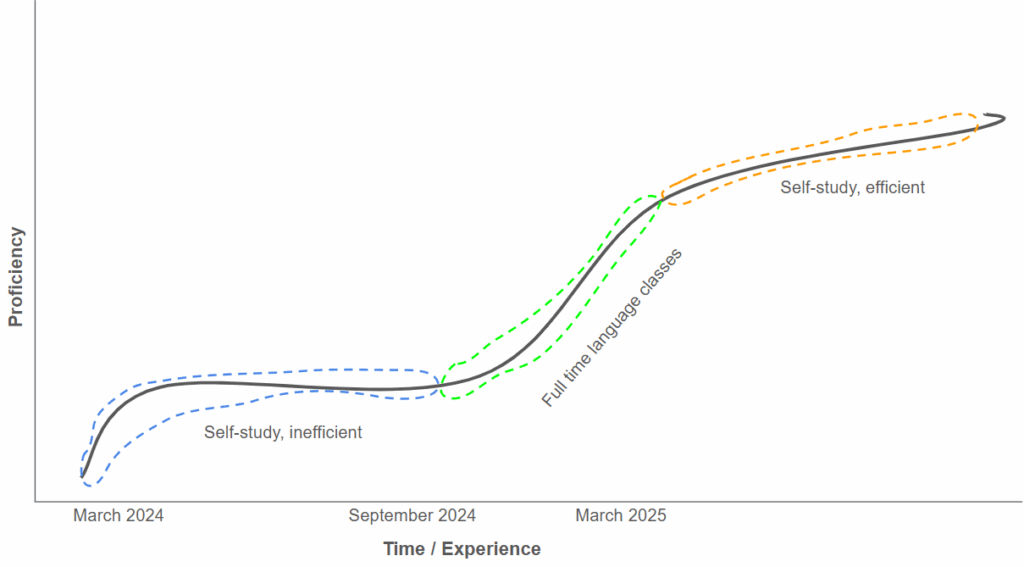
Visually, this concept can be represented by a graph showing time or experience on the x-axis, and proficiency on the y-axis.
Here’s an actual depiction of what my Spanish learning curve has looked like since I started learning the language in March 2024:
Why the Learning Curve Matters
Michael Jordan said something else in the clip that captures the essence of why learning curves matter.
…the effort was there and the learning curve, and the passion was there, that this transcended not just to me, but to other people who are afraid to do things because they are worried about the perception that may come from other places.
The important subtext of what he’s saying is that by understanding and accepting that learning curves exist, we can be brave enough to try new things — even knowing we may be bad at them early on.
And by giving them effort and passion, we will eventually improve — which is something that will always make us proud regardless of the end result.
Riding Learning Curves to Success
So how do we achieve really big things in our lives?
The answer is by riding learning curves to success — and that starts by having a deep understanding of what’s really happening along the x-axis of each curve.
Take a look at the updated x-axis for my Spanish learning curve below:
time x effort x efficiency x talent
Now we can see what’s really going on under the hood: the combination of time, effort, efficiency, and talent working together to move us toward mastery.
Let’s dive into each of these to understand their role.
Time
Time is the most essential component of the learning curve because given enough time to learn or practice something, most of us will improve quite a bit.
That said, the more complex something is, the longer it takes to improve. For instance, here’s a look at my software development learning curve — which you’ll notice is a lot flatter than my Spanish curve. That means it takes longer to master.
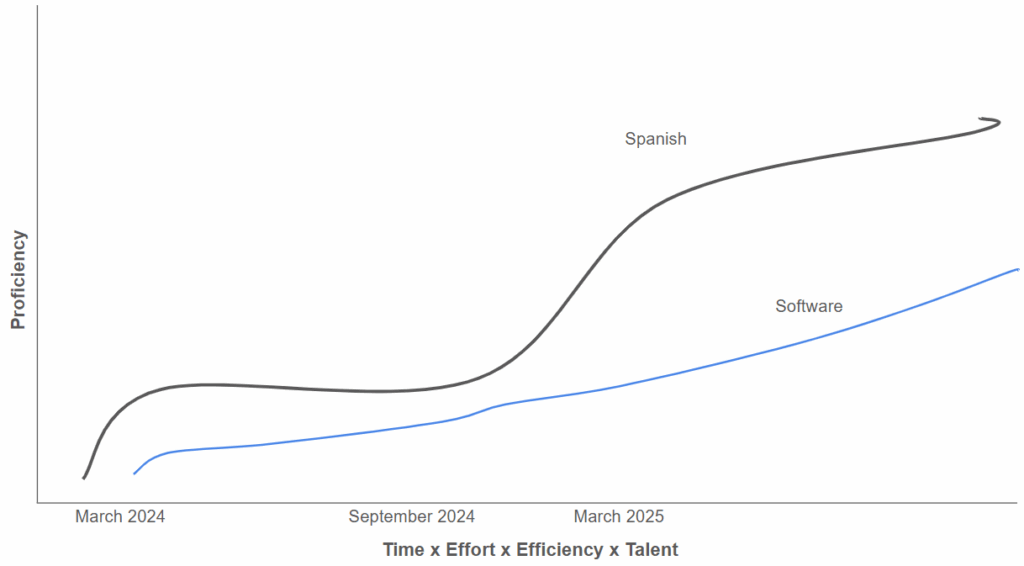
The key thing to know about the time variable is that it’s weak on its own.
Take my friend, for example, who’s been learning Spanish for five years and still isn’t fluent. The reason is because he hasn’t paired the time variable with the most important one of them all — effort.
Let’s talk about that next..
Effort
You’ll notice in Michael Jordan’s quote above that even before mentioning the learning curve, he mentions effort. That’s because effort is the catalyst for all learning and mastery.
When combined with time, effort becomes like an avalanche of potential — slowly building until it finally gives way to competence and performance.
Back in high school, when my friends and I lifted weights, one of our basketball coaches would pop in, catch us standing around chatting, and yell his signature line of “You’re not gonna get big just staring at the weights!”
It was always a good laugh, but he was reminding us that time in the gym isn’t enough — it’s the effort you put in during that time that really counts.
And the same still applies now as adults, in whatever skill or pursuit we’re chasing.
Efficiency
Time and effort are enough to make progress, but the real magic happens when you reach efficiency.
It reminds me of when legendary football coach Vince Lombardi said:
Practice does not make perfect. Only perfect practice makes perfect.
Vince Lombardi
What he meant is that while practicing and giving effort is good, it’s far more powerful to practice well and efficiently.
Two people can have the same natural ability and put in the same amount of time doing the same thing, yet still get drastically different results. Why? Because one of them was more efficient.
Efficiency in studying might mean concentrating deeply and absorbing more without needing to backtrack. In something physical, it could mean practicing under conditions that mimic real performance so you’re adapted when it counts. Even something like learning to be a better parent could mean simply not making the same mistake twice.
Efficiency is all about reflecting and adapting — refining your process to get closer to perfection each time.
Talent
Talent is the variable least in our control — and that’s actually a good thing, because it means we don’t have to think too much about it.
If you’re born with talent for something, great — you’ll have an easier time mastering it. If you’re not, you’ll have to work a bit harder. But regardless of where you fall on the spectrum, the formula for improvement stays the same.
A word of caution, though: talent can hold you back if you’re not careful.
I’ve seen plenty of athletes who were naturally gifted but thought they didn’t need to work as hard. Over time, they got passed up by guys with less talent but stronger work ethic.
Don’t be one of those guys.
Closing Thought On The Learning Curve
Life offers us tremendous opportunities to achieve great things — but the cost of admission is usually hours upon hours of painstaking, focused work.
It’s easy to get caught up in results or how hard something feels, but it’s much slicker to tune all that out and focus on the curve itself — and the factors within your control.
Because the curve is where the growth lives.
The only question is: will you stay on it long enough to see what’s waiting on the other side?